Stochastic heat 2D (stochastic_heat_2d)
Additive space-time noise on two-dimensional diffusion, with an ensemble per initial condition. The linear structure makes this the cleanest test case in the catalogue for uncertainty methods: the conditional distribution is Gaussian and its covariance is known analytically, so a predicted spread can be checked against the truth rather than only against a held-out sample.
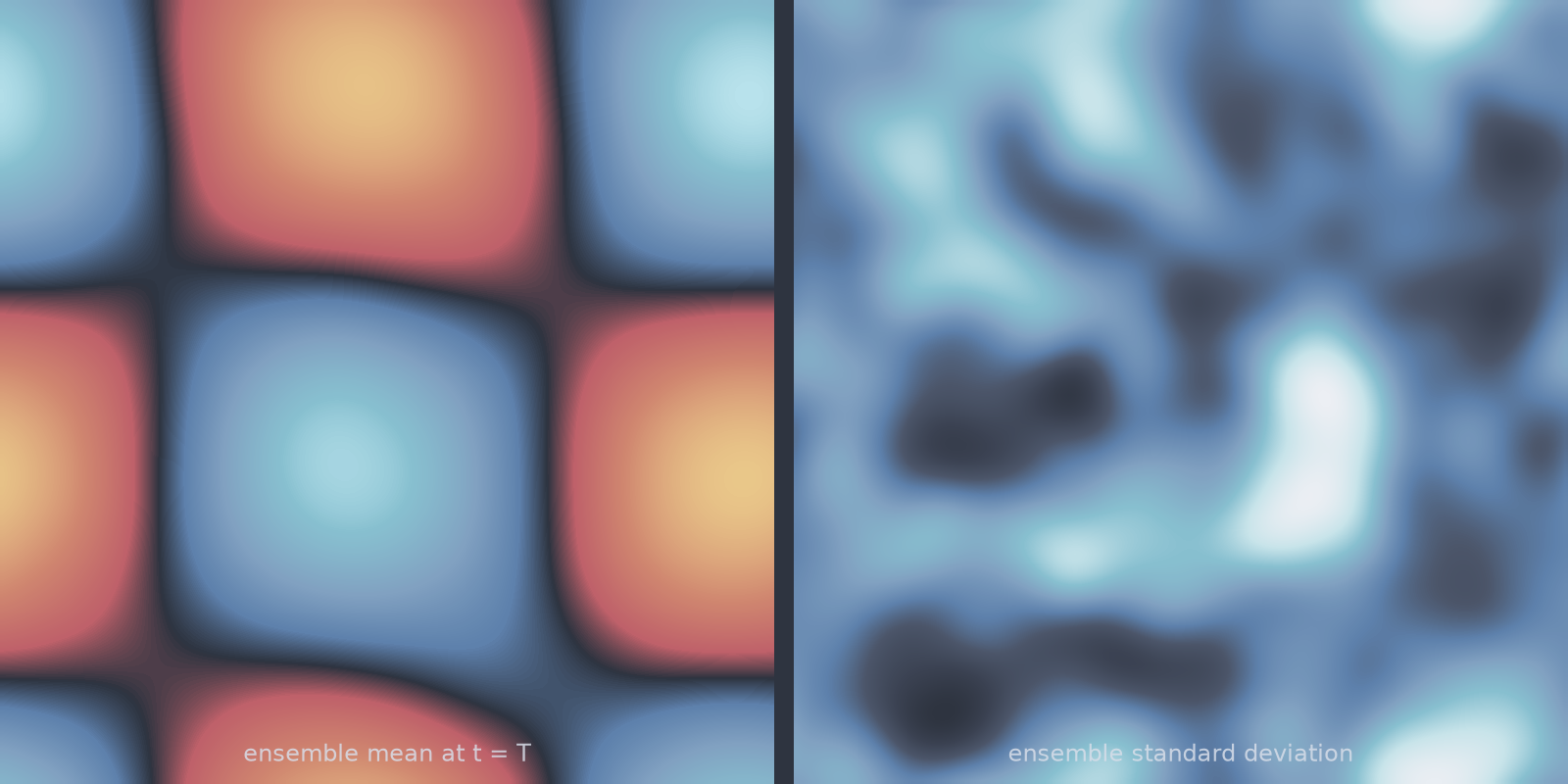
stochastic_heat_2d): the mean follows the deterministic solve, the spread does not.Equation
with periodic boundary conditions.
Operator learning tasks
- Realisations. \(u_0 \mapsto \{u_T^{(1)}, u_T^{(2)}, \dots\}\)
- Moments. \(u_0 \mapsto (\mathbb{E}[u_T],\ \operatorname{Var}[u_T])\)
Parameters
| Parameter | Default | Range | Description |
|---|---|---|---|
diffusivity |
0.01 | (1e-6, 1.0) | Thermal diffusivity \(\alpha\) |
noise_intensity |
0.1 | (0.0, 1.0) | Noise amplitude \(\sigma\) |
n_realizations |
20 | (1, 200) | Realisations per initial condition |
time_end |
1.0 | (0.01, 10.0) | Final time |
Usage
from pdeforge import generate_dataset

dataset = generate_dataset(
    model="stochastic_heat_2d",
    n_samples=50,
    resolution={"x": 64, "y": 64},
    params={"diffusivity": 0.01, "noise_intensity": 0.1, "n_realizations": 20},
    seed=42,
)
dataset.outputs.shape   # (50, 20, 64, 64)
Storage grows with the ensemble
Outputs are n_samples * n_realizations fields. At \(64^2\) in float64 that
is 32 KB per field, so the call above stores 32 MB and raising
n_realizations to 200 stores 320 MB. Pass to= to stream to disk.
Solver
Exponential integrator for the exact diffusion with Euler-Maruyama noise
increments, matching the conventions of the other stochastic models. At
\(\sigma = 0\) the model reduces to heat_2d.
Behaviour
The mean of the ensemble follows the deterministic solution exactly, because
additive noise has zero mean and the equation is linear. All the information
that distinguishes this model from heat_2d therefore lives in the second
moment, and a metric computed on the ensemble mean alone will show no
difference at all.
Data shapes
dataset.inputs.shape   # (n_samples, ny, nx)
dataset.outputs.shape  # (n_samples, n_realizations, ny, nx)
Related
heat_2d: the deterministic limit.stochastic_heat_1d: the one-dimensional version.stochastic_allen_cahn_2d: noise on bistable dynamics, where realisations can end in different states entirely.