Allen-Cahn 2D (allen_cahn_2d)
Phase separation on the square. In two dimensions the interfaces are curves, and curves move under their own curvature: droplets shrink and vanish, and domains coarsen with a growing characteristic scale. The operator task inherits that geometry, since predicting the field at time \(T\) means predicting which droplets survived.
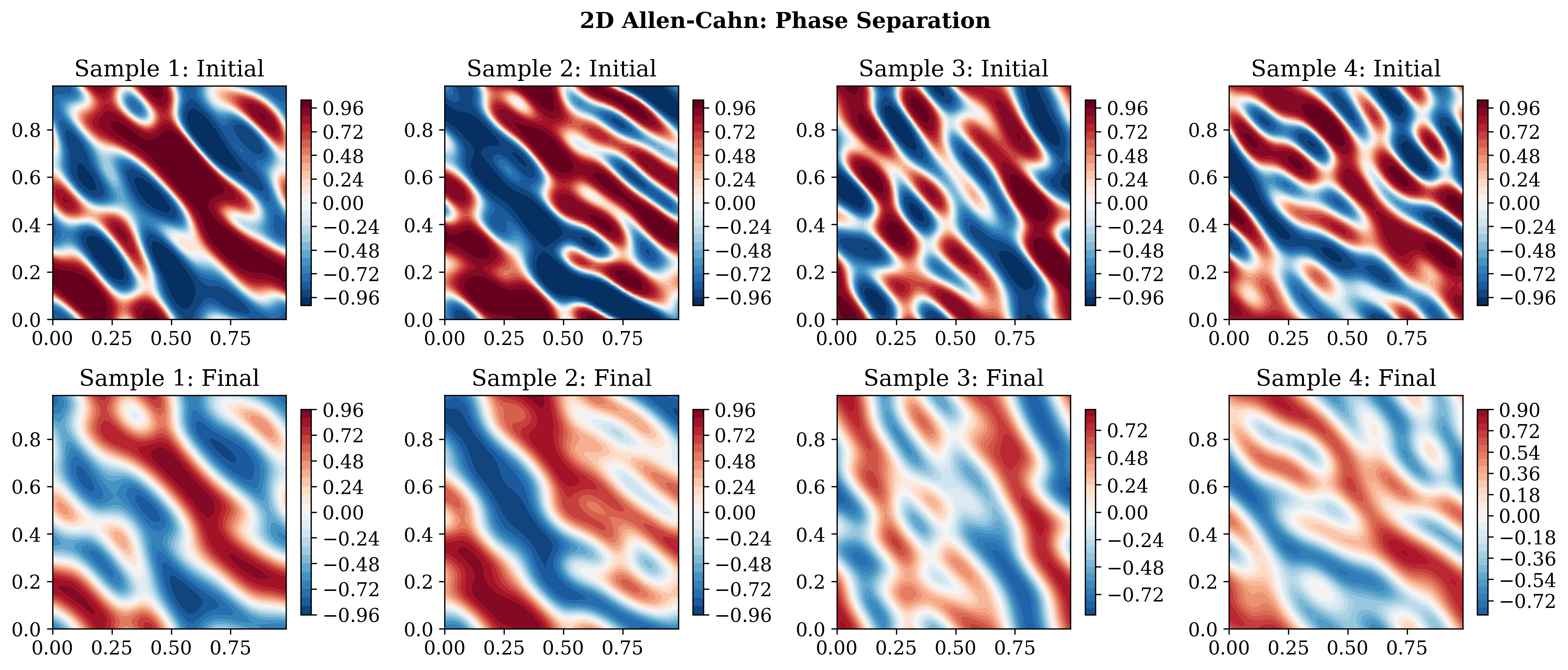
allen_cahn_2d): domains of the two wells separated by thin interfaces.Equation
with periodic boundary conditions.
Operator learning task
Parameters
| Parameter | Default | Range | Description |
|---|---|---|---|
epsilon |
0.01 | (0.001, 0.5) | Interface width |
time_end |
10.0 | (0.1, 100.0) | Final time; longer gives coarser domains |
Usage
from pdeforge import generate_dataset

dataset = generate_dataset(
    model="allen_cahn_2d",
    n_samples=500,
    resolution={"x": 64, "y": 64},
    params={"epsilon": 0.01, "time_end": 10.0},
    seed=42,
)
Solver
Semi-implicit IMEX stepping on the spectral grid: the cubic reaction is
stepped explicitly, then diffusion is applied implicitly in Fourier space,
where the update is a diagonal division. The splitting is first order in
time, and the coarsening dynamics it is used for are slow enough that the
splitting error is not the binding constraint. Note this differs from
allen_cahn_1d and allen_cahn_3d,
which ride the ETDRK4 seam.
Behaviour
Coarsening is a slow, self-similar process: the mean domain size grows roughly
as \(\sqrt{t}\) under curvature flow, so equal increments of time_end buy
progressively less change. A dataset that varies the horizon linearly will
therefore sample the early dynamics far more densely than the late ones.
The volume fraction is not conserved here, which is the substantive
difference from cahn_hilliard: a domain that shrinks
away is gone, and the whole field can end up in one well.
Data shapes
Related
allen_cahn_1d,allen_cahn_3d: the other dimensions.cahn_hilliard: conserved dynamics, giving interconnected morphologies instead.stochastic_allen_cahn_2d: the same model with space-time noise and an ensemble per input.