Heat 3D (heat_3d)
The three-dimensional twin of heat_1d and
heat_2d, and the model to reach for when the question is
whether an architecture survives a volumetric field at all. The physics holds
no surprises; the memory does.
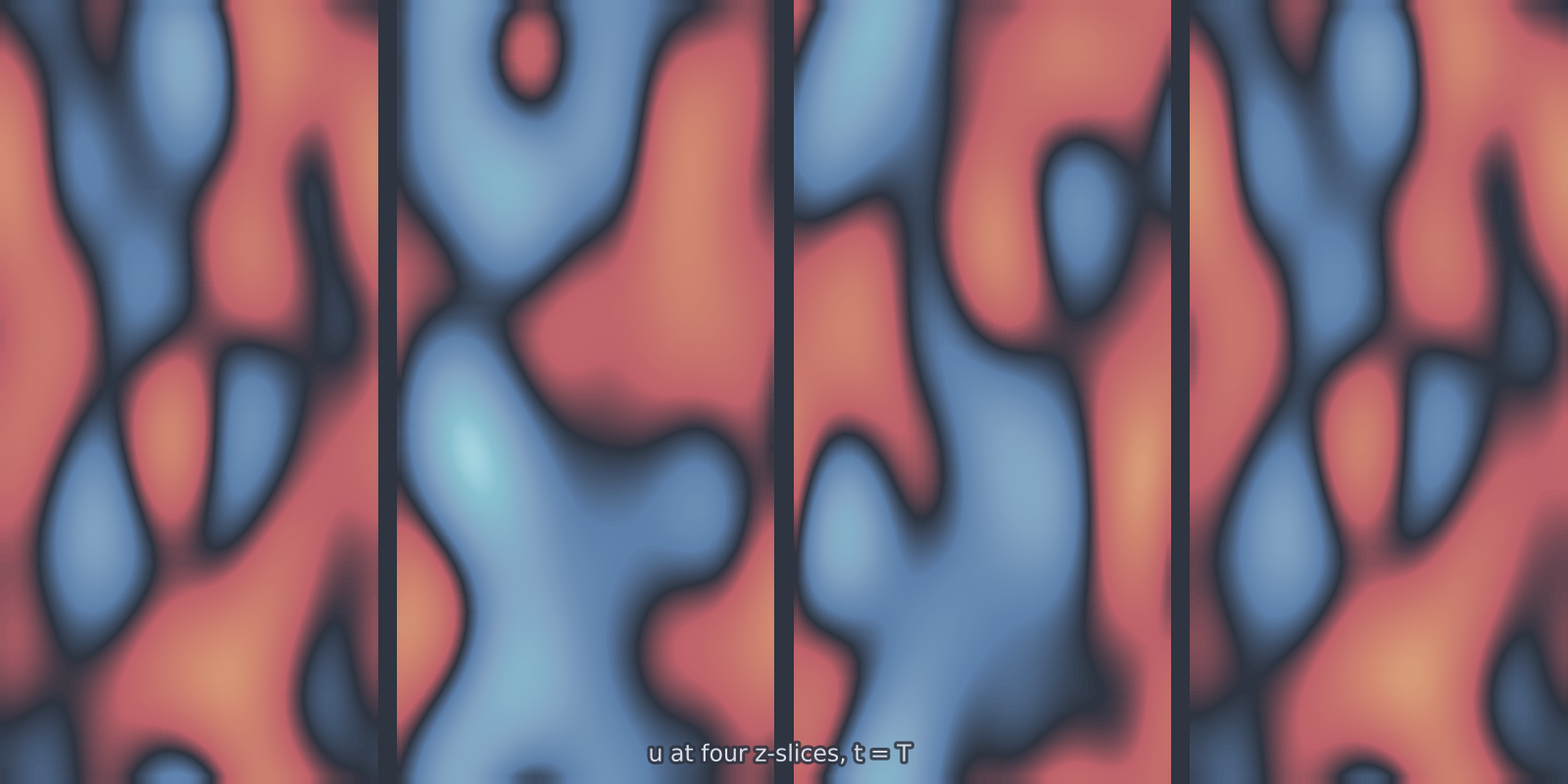
heat_3d): the diffused field on the periodic cube.Equation
\[\frac{\partial u}{\partial t} = \alpha \nabla^2 u\]
on the periodic cube.
Operator learning task
\[u(x, y, z, 0) \mapsto u(x, y, z, T)\]
Parameters
| Parameter | Default | Range | Description |
|---|---|---|---|
diffusivity |
0.01 | (1e-6, 1.0) | Thermal diffusivity \(\alpha\) |
time_end |
1.0 | (0.01, 10.0) | Final time \(T\) |
Usage
from pdeforge import generate_dataset

dataset = generate_dataset(
    model="heat_3d",
    n_samples=200,
    resolution={"x": 64, "y": 64, "z": 64},
    params={"diffusivity": 0.01, "time_end": 1.0},
    seed=42,
    to="heat3d.h5",     # write straight to disk, chunked
)
Solver
The spectral seam is dimension-agnostic: it runs fftn over however many
spatial axes the resolution dict declares, so this is heat_1d's code path
with one more axis. Propagation stays exact.
Mind the memory
A single \(64^3\) field in float64 is 2 MB, so inputs and outputs together
come to 4 MB per sample: a 1000-sample set is 4 GB in RAM if you ask for it
all at once. Pass to= to stream chunks to disk, which is what the
chunk_size argument exists for.
Data shapes
Related
allen_cahn_3dandcahn_hilliard: the other volumetric models, both with real 3D structure to resolve.darcy_fno_3d: the steady elliptic problem on the cube.