Stochastic Allen-Cahn 2D (stochastic_allen_cahn_2d)
Phase separation with thermal fluctuations, and the model where the ensemble genuinely branches. Noise nucleates and roughens interfaces, and strong enough noise flips whole domains between the \(\pm 1\) wells. Two realisations from the same initial condition can therefore end up in different macroscopic states, which is a qualitatively different kind of uncertainty from the perturbative spread of the linear models.
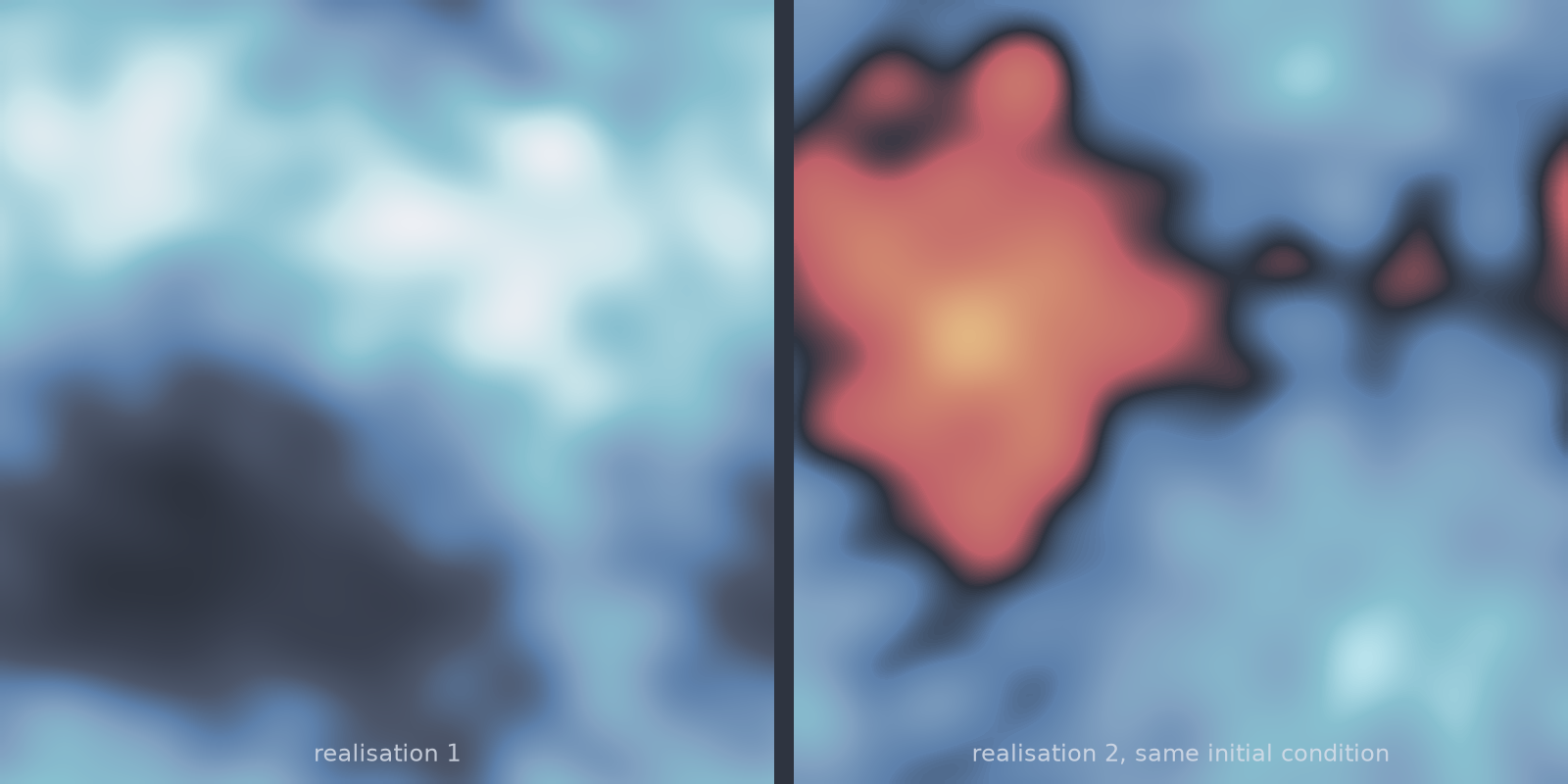
stochastic_allen_cahn_2d): the domain pattern is not shared.Equation
on the periodic box.
Operator learning task
Parameters
| Parameter | Default | Range | Description |
|---|---|---|---|
epsilon |
0.01 | (0.001, 0.5) | Interface parameter |
noise_intensity |
0.05 | (0.0, 2.0) | Noise amplitude \(\sigma\) |
n_realizations |
10 | (1, 1000) | Realisations per initial condition |
time_end |
2.0 | (0.05, 100.0) | Final time |
Usage
from pdeforge import generate_dataset

dataset = generate_dataset(
    model="stochastic_allen_cahn_2d",
    n_samples=100,
    resolution={"x": 64, "y": 64},
    params={"epsilon": 0.01, "noise_intensity": 0.05, "n_realizations": 20},
    seed=42,
)
dataset.outputs.shape   # (100, 20, 64, 64)
Solver
Exponential integrator for the linear part, meaning diffusion together with the linear reaction term, explicit cubic, and Euler-Maruyama noise. At \(\sigma \to 0\) the deterministic phase-separation dynamics is recovered.
Behaviour
The distribution over outcomes is multimodal, and that breaks the usual
uncertainty summaries. An ensemble mean taken across realisations that settled
into different domain patterns is a blurred field belonging to no member, and a
per-point variance reports a large number everywhere the members disagree
without saying that they disagree about the pattern rather than the value.
Conditional-distribution methods have something real to do here in a way they
do not for stochastic_heat_2d.
Noise intensity sets how often branching happens. At the default 0.05 the interfaces roughen but domains rarely flip; raising it towards 0.5 makes flips routine.
Data shapes
dataset.inputs.shape   # (n_samples, ny, nx)
dataset.outputs.shape  # (n_samples, n_realizations, ny, nx)
Related
allen_cahn_2d: the deterministic model.stochastic_heat_2d: unimodal, Gaussian, and much easier to summarise.- The stochastic systems guide.