Cylinder Flow 2D parameterized (cylinder_flow_2d_parameterized)
The same steady solve as cylinder_flow_2d with the
cylinder position promoted to an input. Moving the obstacle changes the
geometry, so the mesh is rebuilt per sample and the flow field that comes back
is genuinely a different problem's solution rather than a rescaling of one
reference flow. That is what makes it useful: the operator has to learn how
geometry maps to flow, which is the hard part of most engineering surrogates.
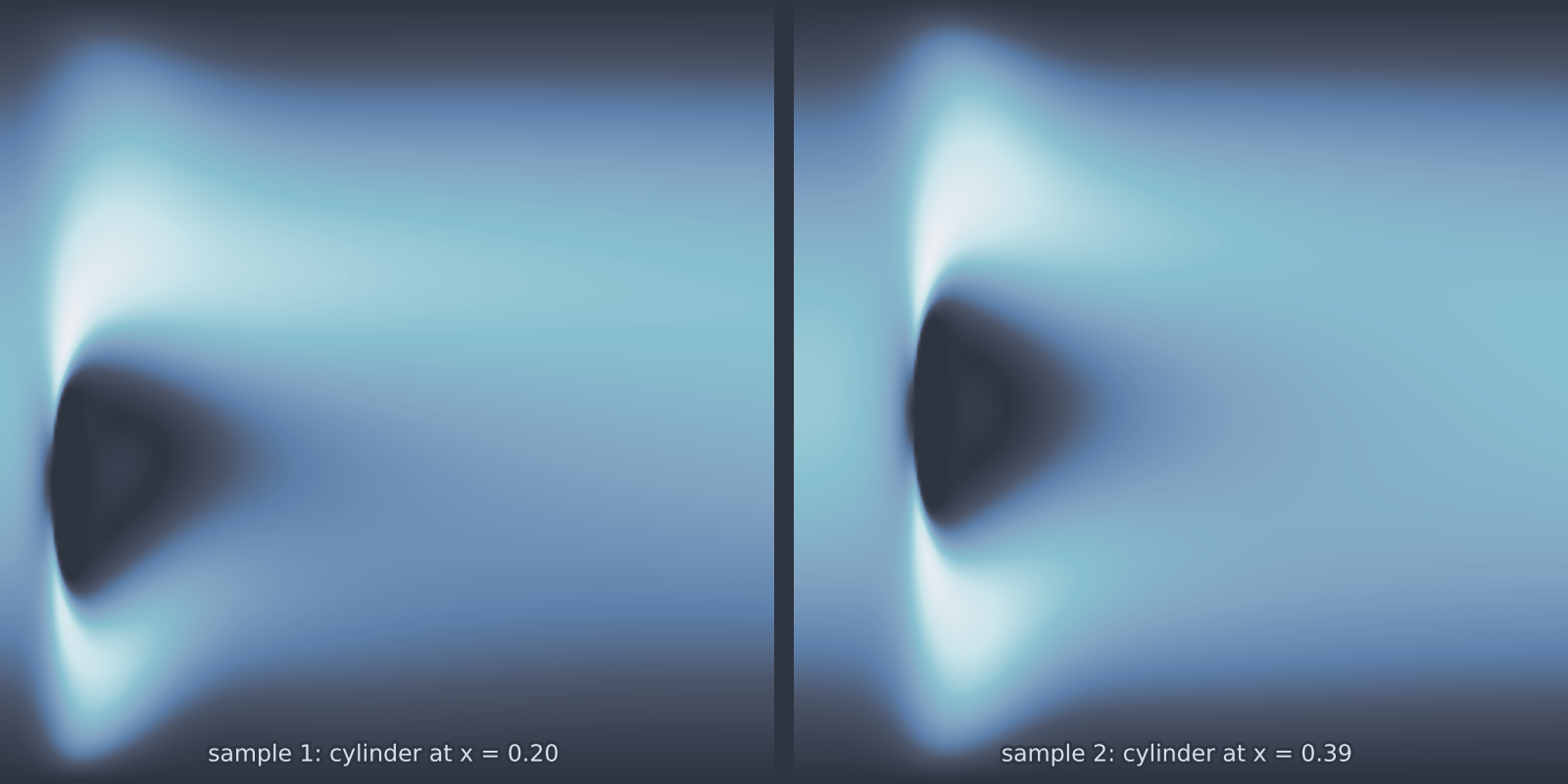
cylinder_flow_2d_parameterized): the wake follows the obstacle.Equations
with a parabolic inlet, zero-stress outlet, and no slip on the walls and the cylinder.
Operator learning task
Parameters
| Parameter | Default | Range | Description |
|---|---|---|---|
inlet_velocity |
0.3 | (0.01, 2.0) | Mean inlet velocity |
viscosity |
0.001 | (1e-5, 0.1) | Dynamic viscosity |
cylinder_radius |
0.05 | (0.01, 0.1) | Cylinder radius |
cx_range |
(0.15, 0.5) | Draw range for the cylinder \(x\) position | |
cy_range |
(0.15, 0.26) | Draw range for the cylinder \(y\) position |
The cy_range is deliberately narrow, since the channel is only 0.41 tall and
a cylinder of radius 0.05 placed near a wall leaves a gap the mesh has to
resolve. Widening it is possible, and will make meshing harder.
Usage
This model needs FEniCSx. See FEniCSx setup.
from pdeforge import generate_dataset

dataset = generate_dataset(
    model="cylinder_flow_2d_parameterized",
    n_samples=200,
    resolution={"x": 110, "y": 41},
    params={"viscosity": 0.001, "cx_range": (0.15, 0.5)},
    seed=42,
)
Solver
As in the fixed-position model: Taylor-Hood P2/P1 elements, Newton for the nonlinearity, gmsh for the mesh. The mesh is regenerated for each new cylinder position, which is most of the per-sample cost.
Behaviour
Because the obstacle moves, the region occupied by fluid differs from sample
to sample and the domain_mask differs with it. Averaging error over the full
grid mixes fluid points with points that are inside the cylinder in some
samples and outside it in others, which is worth avoiding.
Cylinder position near the inlet leaves a longer channel for the wake to develop in; near the outlet the wake is truncated by the boundary. Those are visibly different flows, and the position range therefore controls how varied the dataset is.
Data shapes
dataset.inputs.shape   # (n_samples, 3)            inlet scale, cx, cy
dataset.outputs.shape  # (n_samples, nx, ny, 3)    u, v, p
Related
cylinder_flow_2d: the fixed-position steady solve.cylinder_flow_2d_turbulent: the same position parameterisation at Re 2000, unsteady.naca_flow_2d: geometry as input, taken further: the shape itself is drawn per sample.