NACA Flow 2D (naca_flow_2d)
Geometry is the data. Every sample draws its own airfoil, meaning thickness, camber, camber position and angle of attack, plus an inlet-velocity scale; the channel is re-meshed around it, and the solve returns the fields on a regular grid together with the lift and drag coefficients from the surface stress integral. The targets are the FlowBench ones, from a generator with knobs rather than a frozen download.
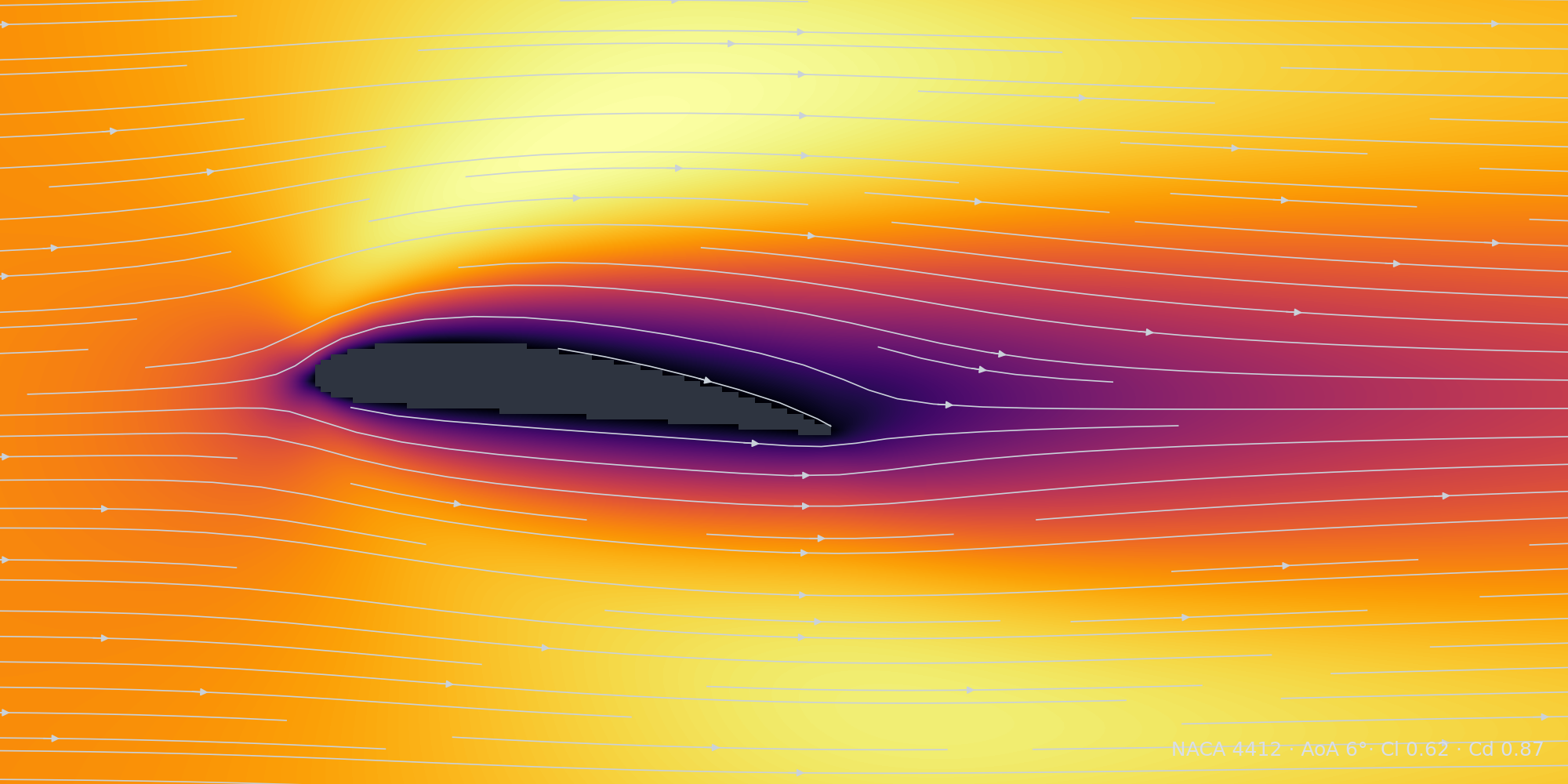
naca_flow_2d), with the lift and drag from the surface stress integral.Equations
Steady incompressible Navier-Stokes in a channel around the airfoil:
with uniform far-field velocity on the inlet, top and bottom, a natural outlet, and no slip on the airfoil.
Operator learning task
Per-sample parameters and the coefficients \((C_l, C_d)\) are recorded in the dataset metadata.
Parameters
| Parameter | Default | Range | Description |
|---|---|---|---|
viscosity |
0.02 | (0.001, 1.0) | Dynamic viscosity; \(\mathrm{Re} = U c / \nu\) |
inlet_velocity |
1.0 | (0.1, 5.0) | Far-field velocity \(U\) |
thickness_range |
(0.08, 0.18) | NACA thickness draw range, as a chord fraction | |
camber_range |
(0.0, 0.06) | Maximum camber draw range | |
camber_pos_range |
(0.3, 0.6) | Camber position draw range | |
aoa_range |
(-8.0, 8.0) | Angle-of-attack draw range, in degrees |
At the defaults \(U = 1\) and chord 1, so the Reynolds number is 50: a robust steady laminar flow with a real viscous wake.
Usage
This model needs FEniCSx. See FEniCSx setup.
from pdeforge import generate_dataset

dataset = generate_dataset(
    model="naca_flow_2d",
    n_samples=200,
    resolution={"x": 256, "y": 128},
    params={"viscosity": 0.02, "aoa_range": (-8.0, 8.0)},
    seed=42,
)
Solver
Taylor-Hood elements with a Newton/SNES nonlinear solve and a direct LU factorisation, on a mesh rebuilt per sample around the drawn airfoil.
Scope
This is laminar incompressible Navier-Stokes at \(\mathrm{Re} = 50\), and it is
airfoil-class data with knobs. It is deliberately not a recreation of the
transonic Geo-FNO airfoil dataset, nor of RANS-based AirfRANS. For a
shock-carrying compressible condition see
airfoil_euler_2d; for the viscous turbulence-closed
regime PDEForge reads AirfRANS rather than
rebuilding it.
Data shapes
dataset.inputs.shape   # (n_samples, ny, nx)      the signed-distance field
dataset.outputs.shape  # (n_samples, ny, nx, 3)   u, v, p
Related
airfoil_euler_2d: the compressible transonic case, on a body-fitted C-grid.cylinder_flow_2d_parameterized: geometry as input, with position varying rather than shape.stokes_2d: the inertia-free limit.