Porous Darcy FEM (porous_darcy_fem)
The cross-model pipeline, and the answer to a practical complaint about
porous-media datasets: they are usually built by re-slicing one frozen
micro-CT image, so the geometry has no knobs and no independent samples. Here
a seeded cahn_hilliard run grows a spinodal
morphology, thresholding turns it into a two-phase permeability field, and
steady Darcy flow is driven across it. Every seed gives a fresh labyrinth, at
any resolution.
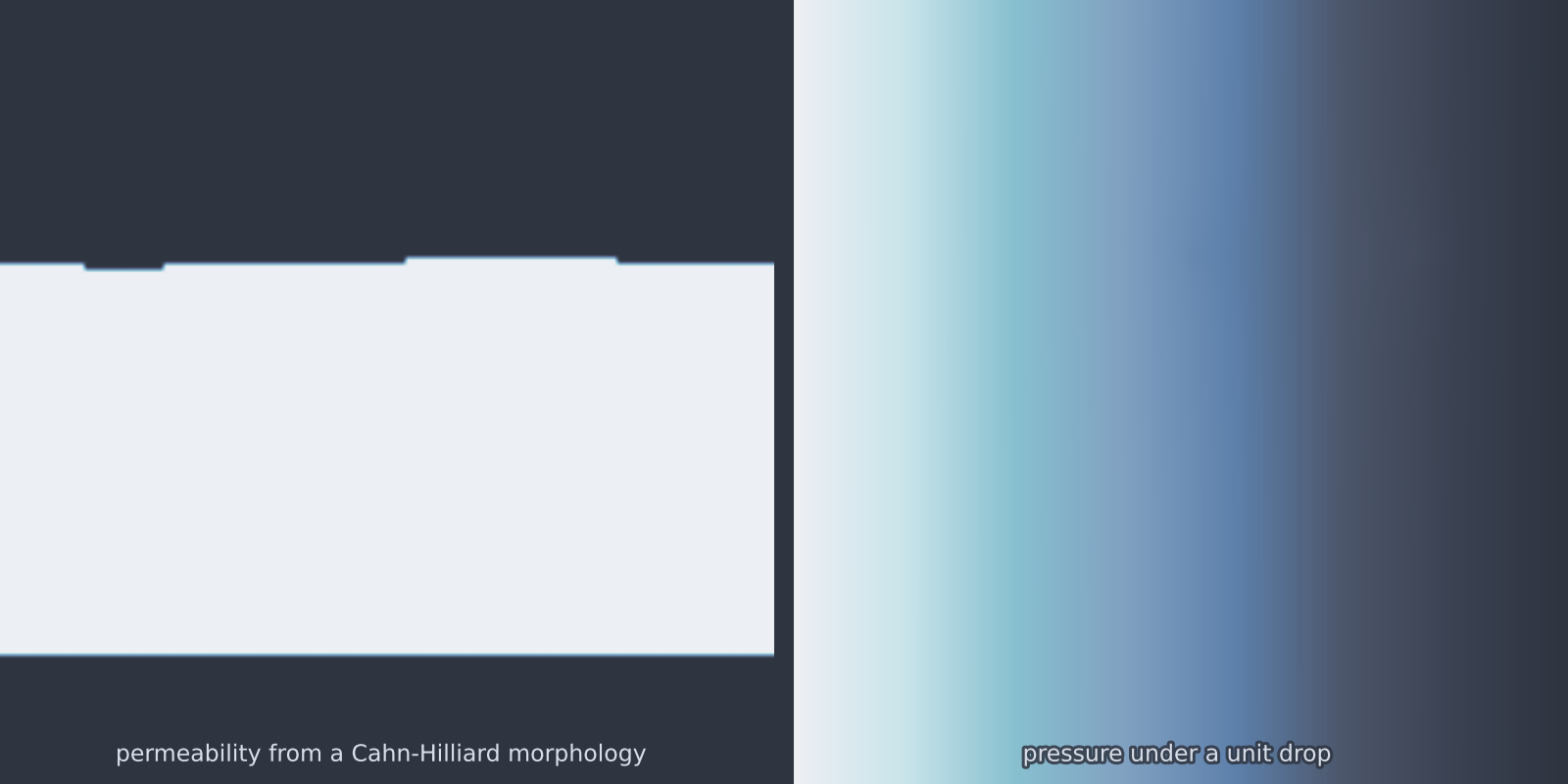
porous_darcy_fem).Equation
with no-flux side walls, and Darcy velocity \(\mathbf{u} = -k\,\nabla p\).
Operator learning task
Parameters
| Parameter | Default | Range | Description |
|---|---|---|---|
permeability_contrast |
1e3 | (10, 1e6) | \(k_{\text{pore}} / k_{\text{solid}}\) |
ch_time |
8.0 | (1.0, 100.0) | Cahn-Hilliard coarsening time of the morphology |
ch_time selects the stage of the microstructure: early gives a fine spinodal
maze, late gives coarse domains. It is a geometry knob dressed as a time,
which is exactly what a frozen image cannot offer.
Raising permeability_contrast confines the flow more tightly to the pore
labyrinth and makes the problem stiffer, since the coefficient jump across
each interface grows with it.
Usage
from pdeforge import generate_dataset

dataset = generate_dataset(
    model="porous_darcy_fem",
    n_samples=100,
    resolution={"x": 64, "y": 64},
    params={"ch_time": 8.0, "permeability_contrast": 1e3},
    seed=42,
)
The effective permeability \(k_{\text{eff}} = Q/\Delta p\) is computed on every solve and returned in that sample's validation record, together with the inflow and outflow used to check the balance.
This model needs FEniCSx. See FEniCSx setup.
Validation
Two checks. Global flux balance compares inflow against outflow across the two pressure boundaries, and the maximum principle for \(p\) requires the pressure to stay within its boundary values everywhere. The effective permeability \(k_{\text{eff}} = Q / \Delta p\) is stored per sample, which also gives a scalar summary to compare across morphologies.
Behaviour
Flow through a high-contrast labyrinth is dominated by a small number of percolating paths, and most of the pore space carries almost nothing. That concentration is the interesting part of the target and the part an averaged metric will not see, since the paths occupy a small fraction of the domain.
Data shapes
dataset.inputs.shape   # (n_samples, nx, ny)      k
dataset.outputs.shape  # (n_samples, nx, ny, 3)   p, ux, uy
The FEniCSx models store space as (nx, ny) with the component axis trailing,
transposed relative to the spectral models' (ny, nx).
Related
cahn_hilliard: the model that grows the geometry.darcy_fno_2d: the same physics on a smooth log-normal coefficient rather than a two-phase microstructure.elasticity_2d: the other heterogeneous-medium FEniCSx model.