Darcy 2D (darcy_2d)
Steady flow through a porous medium, on the periodic box with a spectral
solver. The task is the classic one: hand the operator a permeability field
and ask for the pressure it induces. Where
darcy_fno_2d reproduces the published benchmark down to
its grid convention, darcy_2d is the freer periodic version, useful when you
want the physics without inheriting somebody else's measure.
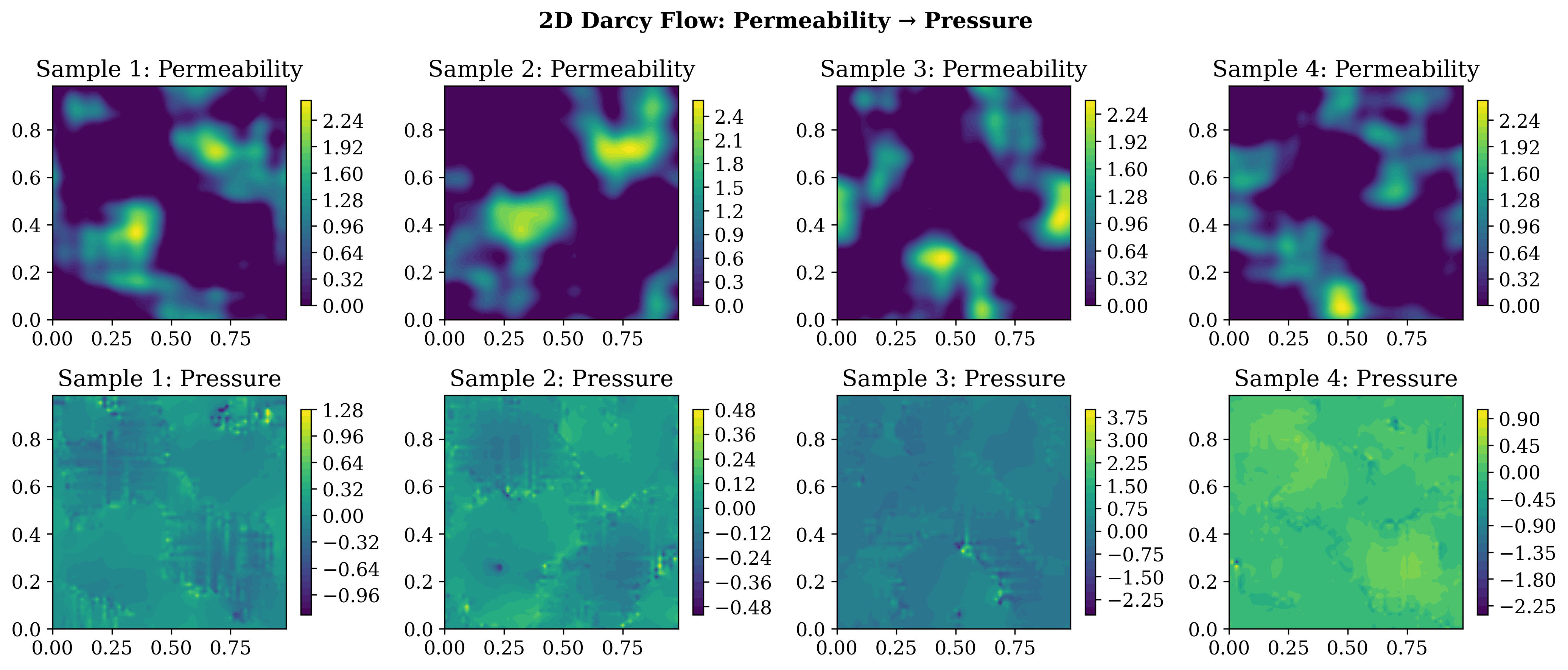
darcy_2d): flow concentrates wherever the medium lets it.Equation
with periodic boundary conditions.
Operator learning task
Parameters
| Parameter | Default | Range | Description |
|---|---|---|---|
kappa_min |
0.1 | (1e-3, 10.0) | Lower end of the permeability range |
kappa_max |
10.0 | (1.0, 100.0) | Upper end of the permeability range |
source_type |
"sine" |
"sine", "constant" |
Forcing \(f\) |
The contrast ratio \(\kappa_{\max}/\kappa_{\min}\) is the parameter that actually sets the difficulty. At the defaults it is 100, which already puts sharp gradients at the interfaces.
describe_model will not list these
They are read from the model's defaults dictionary rather than declared as
tunable specs, so describe_model("darcy_2d") prints
Parameters: See DEFAULT_PARAMS instead of the table above. Passing them
through params= works as documented.
Usage
from pdeforge import generate_dataset

dataset = generate_dataset(
    model="darcy_2d",
    n_samples=1000,
    resolution={"x": 64, "y": 64},
    params={"kappa_min": 0.1, "kappa_max": 10.0},
    seed=42,
)
Solver
Spectral discretisation with conjugate-gradient iteration for the variable-coefficient operator. The periodic setting is what makes the FFT usable here; it is also what distinguishes this model from the Dirichlet benchmark family.
The input measure
Permeability fields come from a Gaussian random field pushed through a sigmoid, which maps the unbounded Gaussian onto \([\kappa_{\min}, \kappa_{\max}]\) and keeps the coefficient strictly positive so the operator stays elliptic. The result reads as smoothly channelised media rather than the two-phase blocks of the piecewise-constant benchmark.
Behaviour
High contrast puts steep pressure gradients along the permeability interfaces, and those interfaces are where a band-limited operator loses accuracy first; smooth permeability gives smooth pressure and a correspondingly easy problem. Wherever the sigmoid produces channelised structures the flow concentrates into them, so a small area of the domain carries most of the signal and an averaged error metric will under-report what went wrong.
Data shapes
Related
darcy_fno_2d: the canonical benchmark, bit-exact against the distributed data.porous_darcy_fem: Darcy flow across a Cahn-Hilliard microstructure, solved by finite elements.helmholtz_2d: the other steady spectral problem.