Cylinder Flow 2D unsteady (cylinder_flow_2d_unsteady)
The von Kármán vortex street. Above a critical Reynolds number the steady
symmetric wake of cylinder_flow_2d loses stability and
the cylinder starts shedding vortices alternately from each side, at a
well-defined frequency. This model returns the whole trajectory rather than an
endpoint, which makes it the catalogue's reference for autoregressive rollout
work on a wall-bounded flow.
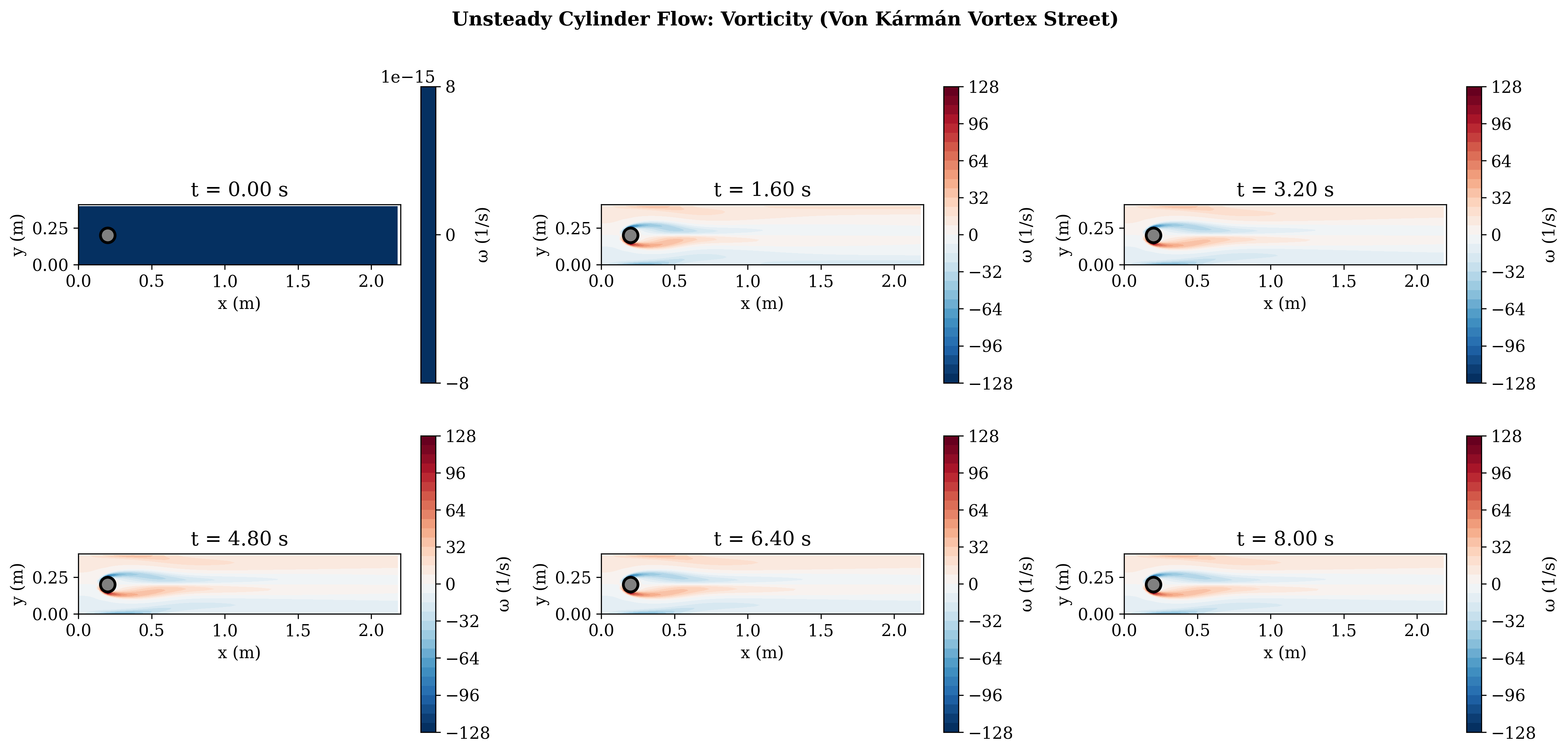
cylinder_flow_2d_unsteady): vortices leave the cylinder alternately from each side.Equations
with a parabolic inlet profile, optionally ramped, zero stress at the outlet, and no slip on the walls and the cylinder.
Operator learning task
Parameters
| Parameter | Default | Range | Description |
|---|---|---|---|
inlet_velocity |
1.0 | (0.1, 3.0) | Mean inlet velocity, which sets Reynolds |
viscosity |
0.001 | (1e-5, 0.01) | Dynamic viscosity; lower gives stronger vortices |
time_end |
8.0 | (1.0, 20.0) | Final time; longer gives more shedding cycles |
Usage
This model needs FEniCSx. See FEniCSx setup.
from pdeforge import generate_dataset

dataset = generate_dataset(
    model="cylinder_flow_2d_unsteady",
    n_samples=10,
    resolution={"x": 110, "y": 41},
    params={"inlet_velocity": 1.0, "time_end": 8.0, "_n_time_steps": 81},
    seed=42,
)
dataset.outputs.shape   # (10, 81, 41, 110, 3)
Solver
Backward Euler in time, chosen for stability at moderate Reynolds rather than for accuracy: the scheme is first order and damps, so a coarse time step will quietly weaken the shedding it is supposed to capture. Space is Taylor-Hood P2/P1 as in the steady model.
Behaviour
Shedding needs time to start. The flow begins from rest or from a ramped
inlet, passes through a transient where the wake is still symmetric, and only
then develops the alternating pattern. A trajectory that stops too early is
mostly transient, so time_end should cover several shedding periods if the
periodic state is what you want to learn.
The one property to watch is the Strouhal number, meaning the shedding frequency: it is the physical quantity a rollout is most likely to get subtly wrong, and a model can look accurate frame by frame while drifting in phase.
Data shapes
dataset.inputs.shape   # (n_samples, 1)
dataset.outputs.shape  # (n_samples, n_t, ny, nx, 3)   u, v, p per frame
Related
cylinder_flow_2d: the steady solve.cylinder_flow_2d_turbulent: Re 2000 with a large-eddy closure and a per-sample cylinder position.ns_vorticity_2d: unsteady incompressible flow without walls.