Cylinder Flow 2D (cylinder_flow_2d)
Flow past a circular cylinder in a channel: the reference geometry of computational fluid dynamics, and the point where PDEForge stops being a spectral package. There are walls here, and a hole in the domain, so the solution lives on an unstructured mesh and is interpolated onto the output grid rather than computed there.
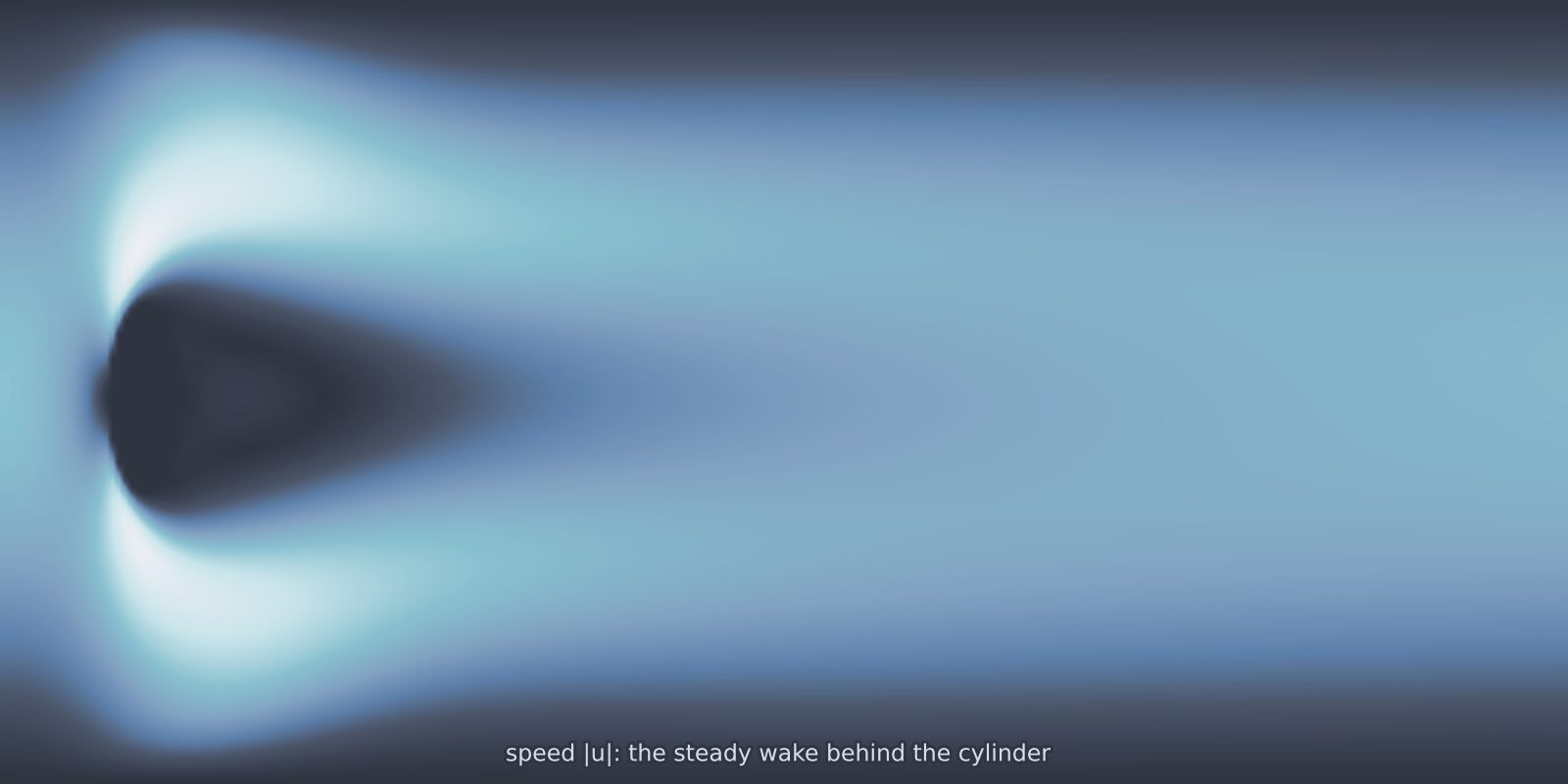
cylinder_flow_2d): the steady, symmetric wake behind the cylinder.Equations
Boundary conditions: a parabolic profile at the inlet, zero stress at the outlet, and no slip on both the channel walls and the cylinder surface.
Operator learning task
Parameters
| Parameter | Default | Range | Description |
|---|---|---|---|
viscosity |
0.001 | (1e-5, 0.1) | Dynamic viscosity \(\mu\) |
inlet_velocity |
0.3 | (0.01, 2.0) | Mean inlet velocity |
cylinder_radius |
0.05 | (0.01, 0.1) | Cylinder radius |
Usage
This model needs FEniCSx. See FEniCSx setup.
from pdeforge import generate_dataset

dataset = generate_dataset(
    model="cylinder_flow_2d",
    n_samples=50,
    resolution={"x": 128, "y": 64},
    params={"viscosity": 0.001, "inlet_velocity": 0.3},
    seed=42,
)
Solver
Finite elements through FEniCSx: Taylor-Hood P2/P1 for velocity and pressure, a Newton solver for the nonlinear terms, and gmsh for meshing the channel with its cylindrical hole.
Domain
The default channel is 2.2 by 0.41 with the cylinder centred at (0.2, 0.2), which is the standard DFG benchmark geometry.
Behaviour
At low Reynolds number the wake is steady and symmetric, which is what this
model is for. Raising Reynolds eventually breaks that symmetry and then starts
shedding vortices, at which point a steady solve has no solution to find and
cylinder_flow_2d_unsteady is the model you
want instead.
Data shapes
dataset.inputs.shape   # (n_samples, 1)            the inlet scale
dataset.outputs.shape  # (n_samples, nx, ny, 3)    u, v, p
Solutions are interpolated from the unstructured mesh onto the regular grid,
and points inside the cylinder are filled with zeros. The domain_mask in the
metadata marks which grid points are genuinely in the fluid, and any error
metric should be computed against that mask rather than the full array.
Related
cylinder_flow_2d_unsteady: the time-dependent version, with vortex shedding.cylinder_flow_2d_parameterized: the cylinder position becomes an input.cylinder_flow_2d_turbulent: Re 2000 under a large-eddy closure.naca_flow_2d: the same solver family around an airfoil.