Stochastic Burgers 1D (stochastic_burgers_1d)
Noise on top of nonlinear dynamics, which is where uncertainty stops being tractable analytically. Burgers concentrates its structure into thin fronts, and the noise perturbs where those fronts sit, so the ensemble spread is not a smooth field: it is a set of narrow, tall ridges at the front locations. A predicted uncertainty that is smooth in space will be wrong in exactly the places that matter.
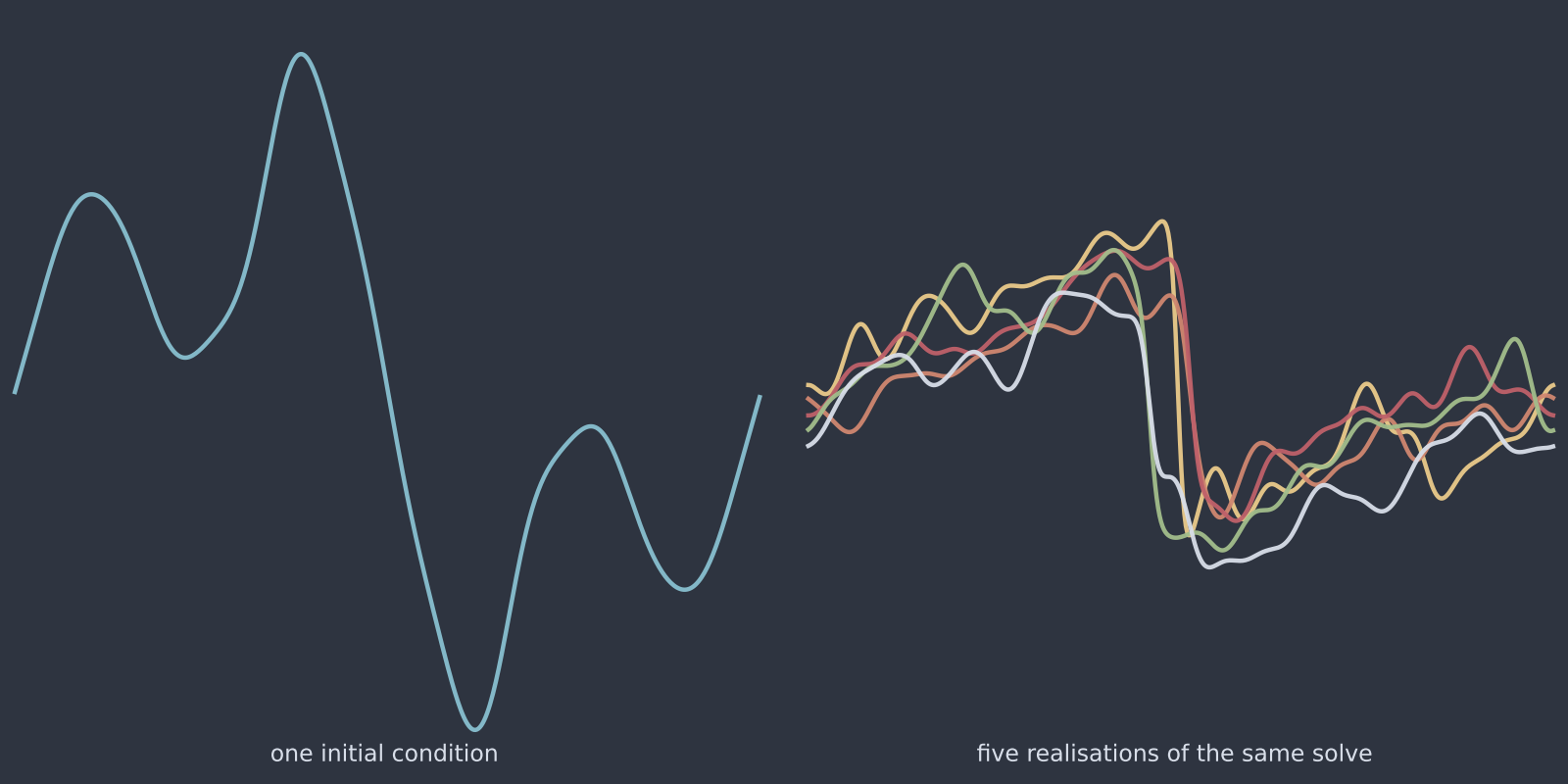
stochastic_burgers_1d): the members agree away from the fronts and disagree at them.Equation
with additive space-time noise, white in time and optionally smoothed in space, on the periodic domain.
Operator learning task
the natural target for distributional operator learning of \(P(u_T \mid u_0)\).
Parameters
| Parameter | Default | Range | Description |
|---|---|---|---|
viscosity |
0.05 | (1e-4, 1.0) | Viscosity \(\nu\) |
noise_intensity |
0.1 | (0.0, 2.0) | Noise amplitude \(\sigma\) |
n_realizations |
10 | (1, 1000) | Realisations per initial condition |
time_horizon |
0.5 | (0.01, 10.0) | Final time \(T\) |
Usage
from pdeforge import generate_dataset

dataset = generate_dataset(
    model="stochastic_burgers_1d",
    n_samples=200,
    resolution={"x": 256},
    params={"viscosity": 0.05, "noise_intensity": 0.1, "n_realizations": 20},
    seed=42,
)
dataset.outputs.shape   # (200, 20, 256)
Solver
Exponential integrator for the exact viscous part, explicit dealiased advection, and Euler-Maruyama noise increments: the same conventions as the stochastic heat models. Sending \(\sigma \to 0\) recovers the deterministic dynamics, which the test suite checks.
Behaviour
The interaction between noise and nonlinearity is the whole point. Because front position depends on the whole history of the field, a small perturbation early produces a displaced front later, and displacing a steep front produces a large pointwise difference. The result is that ensemble variance is concentrated where the deterministic solution has its steepest gradients, and the distribution there is skewed rather than Gaussian.
Raising viscosity widens the fronts and makes the spread better behaved;
lowering it sharpens both the fronts and the failure of any Gaussian
approximation.
Data shapes
Related
burgers_1d: the deterministic model.stochastic_heat_1d: the linear case, where the conditional law stays Gaussian.- The calibration protocol and the stochastic systems guide.