Burgers 1D (burgers_1d)
Burgers is the shortest route from a smooth initial condition to a feature no band-limited method represents well. Advection steepens the profile, viscosity arrests the steepening, and the balance settles at a front of width \(O(\sqrt{\nu})\). Lower the viscosity and the front thins, and the fraction of the domain where the error concentrates thins with it, which is exactly the regime where averaged error metrics stop telling you anything useful.
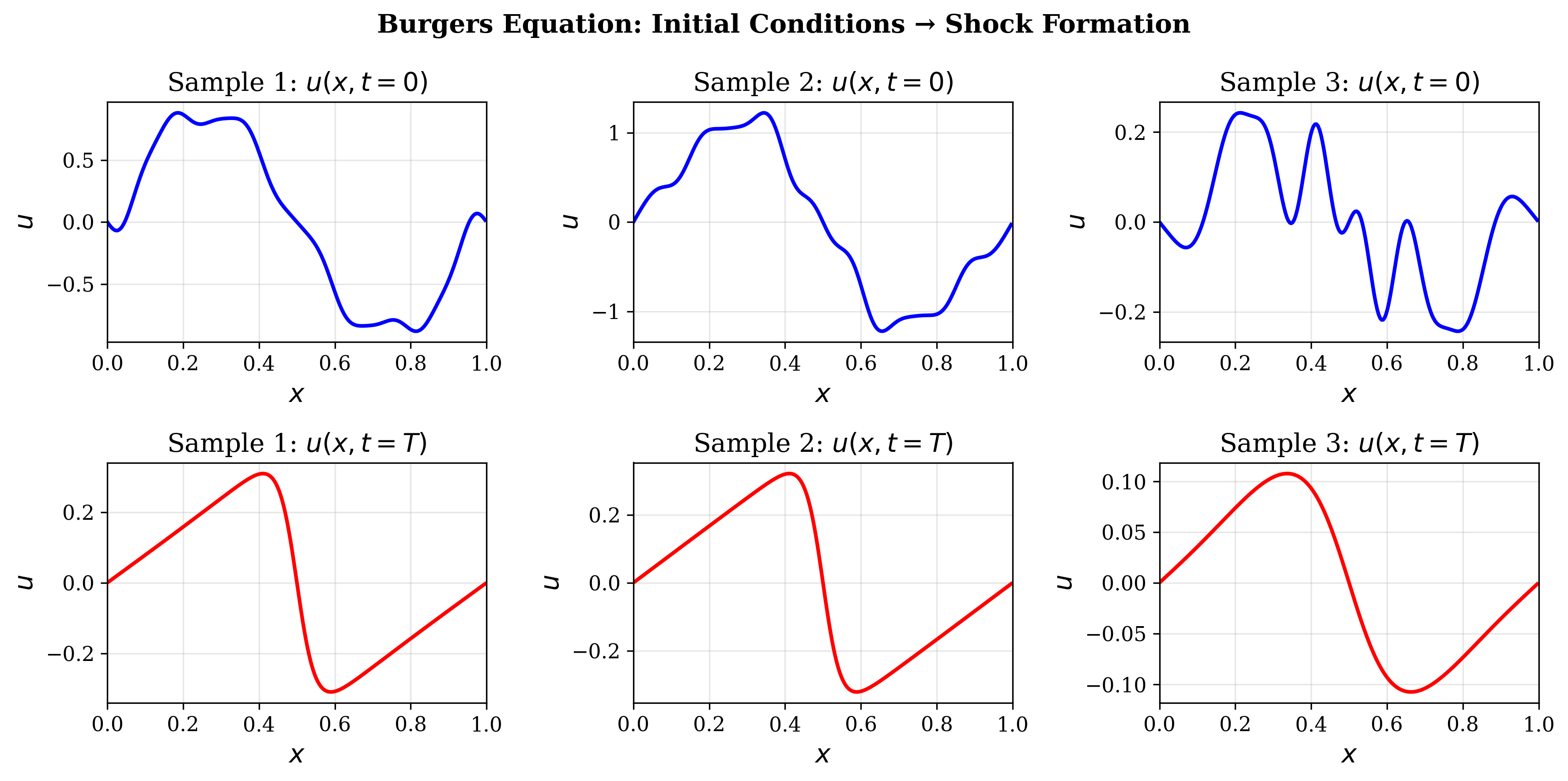
burgers_1d): the profile steepens until viscosity holds the front.Equation
with periodic boundary conditions on \([0, 2\pi]\).
Operator learning task
Parameters
| Parameter | Default | Range | Description |
|---|---|---|---|
viscosity |
\(0.01/\pi\) | (1e-6, 1.0) | Diffusion coefficient \(\nu\) |
time_horizon |
1.0 | (0.1, 10.0) | Final time \(T\) |
The advection coefficient is fixed at 1.0 by default and opened up by the
advection parameter where a published setup needs a different normalisation.
Usage
from pdeforge import generate_dataset

dataset = generate_dataset(
    model="burgers_1d",
    n_samples=1000,
    resolution={"x": 256},
    params={"viscosity": 0.01, "time_horizon": 1.0},
    seed=42,
)
Presets
Three published Burgers setups and a three-rung regularity ladder ship as presets, so the input measure travels with the coefficients:
| Preset | Setup |
|---|---|
fno_burgers_1d |
Sine prior at \(\nu = 0.01/\pi\), \(a_n \sim N(0, 0.49/n^3)\) |
fno_burgers_grf_1d |
The official FNO GRF measure \(N(0, 625(-\Delta + 25)^{-2})\) |
burgers_smooth_1d |
Ladder, smooth end: \(\nu = 0.1/\pi\), 3 modes, nearly featureless |
burgers_canonical_1d |
Ladder, middle: \(\nu = 0.01/\pi\), 9 modes, paper-baseline fronts |
burgers_rough_1d |
Ladder, sharp end: \(\nu = 0.0025/\pi\), 15 modes, front-dominated |
pdebench_burgers_1d |
PDEBench-style low viscosity, shock-rich |
The ladder exists so that front sharpness can be varied without also varying the solver or the sampling: the three rungs share everything except viscosity and the number of excited modes. All three were validated against an independent ETDRK4 reference implementation at about \(3\times10^{-8}\) relative \(L^2\).
Solver
ETDRK4 on the spectral seam. The stiff diffusion term is integrated exactly and only the advection nonlinearity is stepped explicitly, in conservative form with 2/3 dealiasing. That split is what keeps the low-viscosity rungs affordable, since an explicit treatment of diffusion would tie the step size to \(\nu / \Delta x^2\).
Initial conditions
The default generator is a Fourier series with random coefficients,
with amplitudes decaying as \(k^{-\alpha}\). That decay rate is the second difficulty knob alongside viscosity: it sets how much fine structure the front has to form out of.
Behaviour
Low viscosity gives sharp fronts and high viscosity keeps solutions smooth. A longer horizon means more nonlinear evolution and more opportunity for fronts to interact, though on the periodic box the very long-time state is dominated by decay.
Data shapes
Related
burgers_2d: the vector version, with fronts in two dimensions.kdv_1d: the same nonlinearity balanced by dispersion instead, which spreads the difficulty over a wide bore rather than a thin front.stochastic_burgers_1d: the same equation under noise, with an ensemble per initial condition.advection_1d: the linear limit, where the speed no longer depends on the solution.